

Compilation Nation: Tuatara
Or, the Kompiled Kiwis

Stats
Year: 1985
Country: New Zealand
Genre: Indie Rock
Purchase
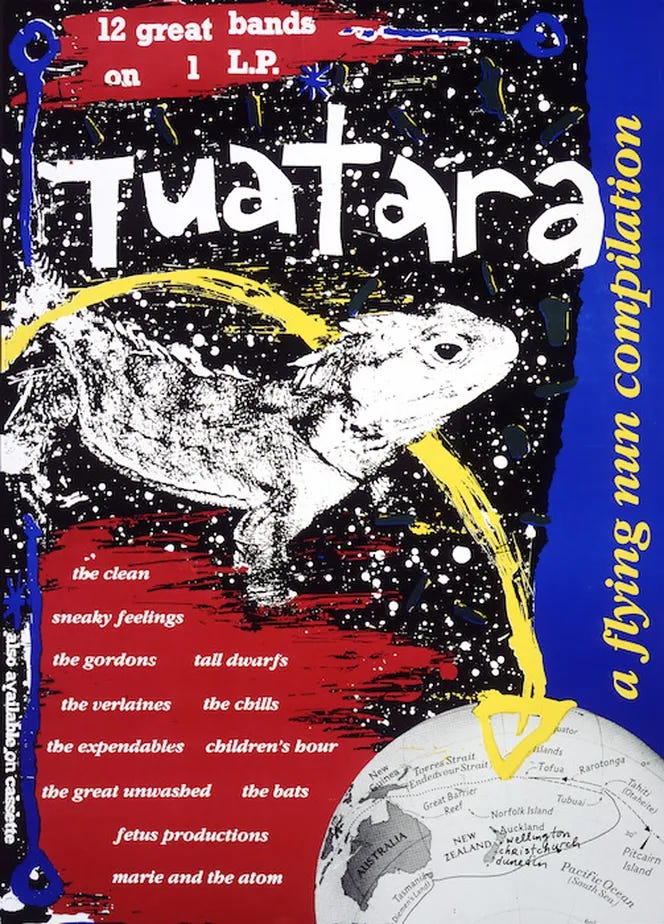
The tuatara is a species of reptile that is native to New Zealand. Outwardly, they resemble lizards, but they descended from the Rhynchocephali, an ancient order of which they are the only members left. In the Māori language, tuatara means “peaks on the back,” which are more pronounced in the males of the species. Other features include a second row of upper teeth and a third “eye” that can detect light. They have more than twice the amount of DNA base pairs as humans and can live for over one hundred years. The tuatara has been protected by NZ law since 1895 due to their endangered status, with populations only residing on offshore islands. In Māori legend, tuatara are the messengers of Whiro, the god of death and disaster.
Here’s a bad joke that an Aussie friend told me:
“Who owns all those reptiles down in New Zealand?”
“I don’t know, but two are Tara’s.”
Tuatara is also the name of a 1985 Flying Nun compilation, which I was able to nab at the WFMU record fair for a cool $40. It’s more than I typically would pay, but for a fan of DIY music scenes, this is an essential artifact. Flying Nun is one of the best-documented small labels to ever exist, to the point that this article only provides a cursory glance at the Dunedin Sound’s legacy, and a whole lot of die-hard fans are going to tell me about the things I got wrong in my research, but it can’t hurt to try.
Founded in 1981 by Roger Shepherd, the label was originally intended to release 7”s in support the music scene of Christchurch, New Zealand, but its trajectory was changed by the scene brewing up in the southern city of Dunedin. 1982’s Dunedin Double was a unique 2×12” featuring four acts that would go on to release again with the label: The Chills, Sneaky Feelings, The Stones, and The Verlaines. Soon, the label moved into LP production, developing a strong roster of jangly, smart, and scrappy bands that would define the musical legacy of New Zealand in both cities for years to come. Their first LP compilation was a series of live recordings in 1984 called The Last Rumba, but 1985’s Tuatara would be their best-known.
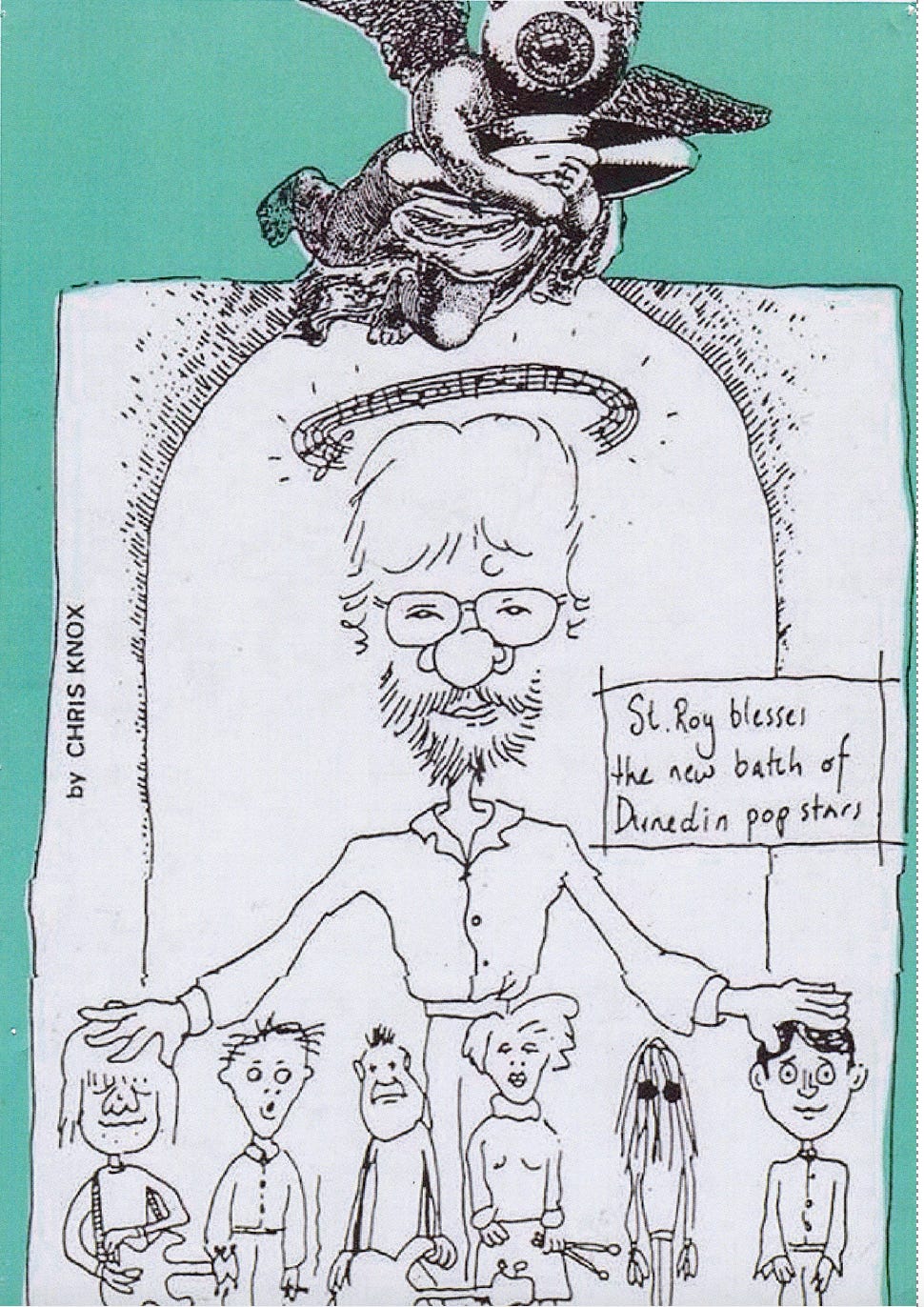
From 40 years in the future, it’s easy to depict Tuatara as a mix between a label sampler and a greatest hits collection, but in 1985, Flying Nun didn’t even have a logo yet. At the time, label guru Roy Colbert claimed that there was no defining sound, but “a definite Flying Nun way of doing things. Flying Nun workers, in fact, run from conventional record company practices like mice from a cat.” His liner notes for Tuatara posit a brief history of the label and its influences, mainly that of Toy Love, who only lasted two years and for most of that time were stationed in Sydney in an attempt to make a name for themselves. The band quickly became disillusioned by the industry and couldn’t find a foothold in the mainstream music market, but their combination of raw aggression with pop-craft sensibilities left a mark on the kids back home, inspiring a “whole wave of young, exciting song-oriented bands.” When Toy Love’s Chris Knox agreed to produce a Clean EP for Flying Nun, Colbert says that the label was marked for success.
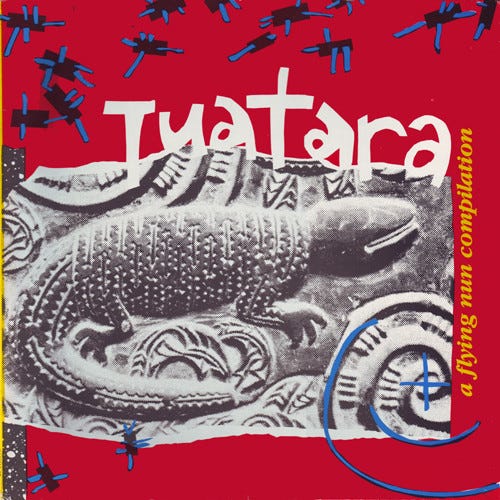
The striking cover art comes from Lesley Maclean, who went by the pseudonym Black Spot, and defined the label’s visual presence during the mid-80s. The bright primary colors and hand-drawn details are a nice contrast to the gatefold, which is filled with scanned monochrome photos of the bands. My version of Tuatara has a big ol’ notch taken out of the top right corner and comes from the only US pressing by Strange Weekend in 1986, a short-lived Kiwi label based in San Francisco. There’s some additional text on the front and back covers to denote the pressing, and the color of the band’s photos in the gatefold is red instead of brown. The weirdest difference is that the orientation of the label print is entirely wrong, making it hard to read which side of the record it is. No matter, it’s the same music.
Content
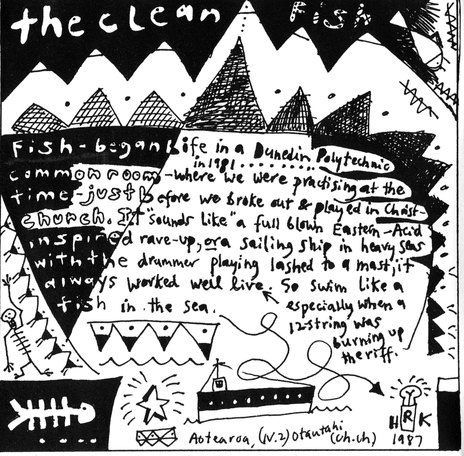
The Clean were Flying Nun’s second band to sign, but to this day, remain their most popular. More interested in singles and EPs than albums, their output was quick but fleeting. “Fish,” the opener of Tuatara, also opened their second EP, Great Sounds (the actual title is much longer), which also included hits like “Beatnik” and “Slug Song.” As a fully instrumental track, each member of the band is focused, playing with a complex, fast rhythm unlike their more loose lyrical work. In a drawing, drummer Hamish Kilgour describes it as an “Eastern-Acid inspired rave-up.” From my perspective, these are the best two and a half minutes of a jam session in its most refined state.
When the Clean split up for the first time in 1982, its members continued to work on other projects. The Great Unwashed became a psych-pop outpost for the Kilgour brothers and original Clean bassist Peter Gutteridge. “Neck Of The Woods” is a natural extension of the jangly sound they were best known for, adding in some kaleidoscopic piano flourishes. This track was first released on a double-7” wrapped in splatter-painted red plastic before switching to a more subdued paper sleeve.
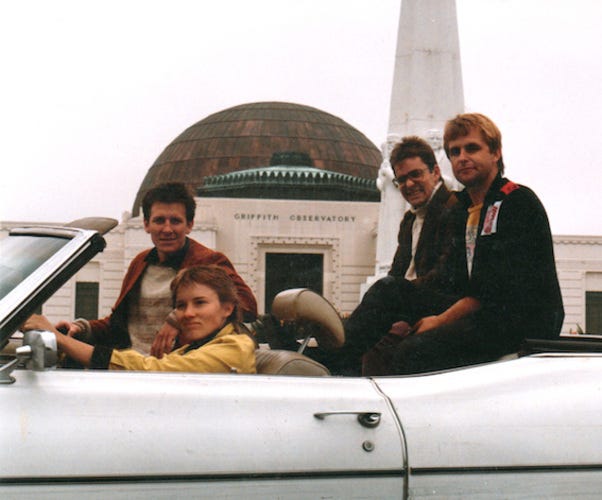
Meanwhile, Clean bassist Robert Scott was working on music with his roommate Kaye Woodward and moved in with Toy Love’s Paul Kean and drummer Malcolm Grant. They formed the Bats, a rare band in that they’ve retained all four members to this day. “I Go Wild” was the opening track off their debut EP By Night, a sturdy strum of hazy memories that combines the band’s delicate nature with their strength as songwriters.
When the Clean were on the bill, it was a good chance that the Chills were there too. Martin Phillipps’ project grew out of the teachings of his musical peers and his time in punk band the Same, which also birthed members of the Stones and Verlaines. After years of experiential education, the Chills felt like a thesis statement. Their second solo single, “Pink Frost,” hit #17 on the pop charts and stuck around for 18 weeks. It’s melancholy yet catchy, and a little weirder than straightforward guitar rock, the best ilk of work that came out of NZ’s indie pockets.
The Verlaines worked with Flying Nun from the very beginning, appearing on Dunedin Double in 1982 and releasing their first solo single, “Death And The Maiden,” inspired by 60’s pop and ramshackle guitars, plus an organ interlude, faux-innocence lyrics, and a tiny speck of garage dirt to show you that these guys did it themselves. Graeme Downes pushes his voice to shine through a sullen gaze and a massive fringe of black hair. You can see it yourself in the music video, with the band playing in a pink living room and on top of a blown-up industrial building. The rest of the cast, dancing with abandon, features a who’s who of the surrounding scene, with members of the Stones, Look Blue Go Purple, and the Chills all in attendance. The group had grown up together in the local schools, went to the University of Otago (where Downes is now a Senior Lecturer), and followed the Clean to projects of their own.
The other Dunedin Double alumni who appear on this record are Sneaky Feelings, who took their name from an Elvis Costello song. They were self-proclaimed outsiders in the scene, but their resulting work had just as much influence in hindsight. “Throwing Stones” from their 1984 EP is a sparkling swirl that calls for lying on the floor and wallowing in your feelings. Even if Sneaky Feelings didn’t feel a part of the Dunedin Sound, there was a whole host of non-conformist bands on the label as well.
Jay Clarkson was a singer-songwriter with a couple of bands over the course of her career, but the one featured on Tuatara is Expendables. She had previously released a 12” EP on Flying Nun with the band They Were Expendable, but when the lineup changed, so did their name. “Man With No Desire” is the B-side of their 1984 single “The Flower,” and although slower and more introspective, Clarkson’s craft feels completely ahead of its time.
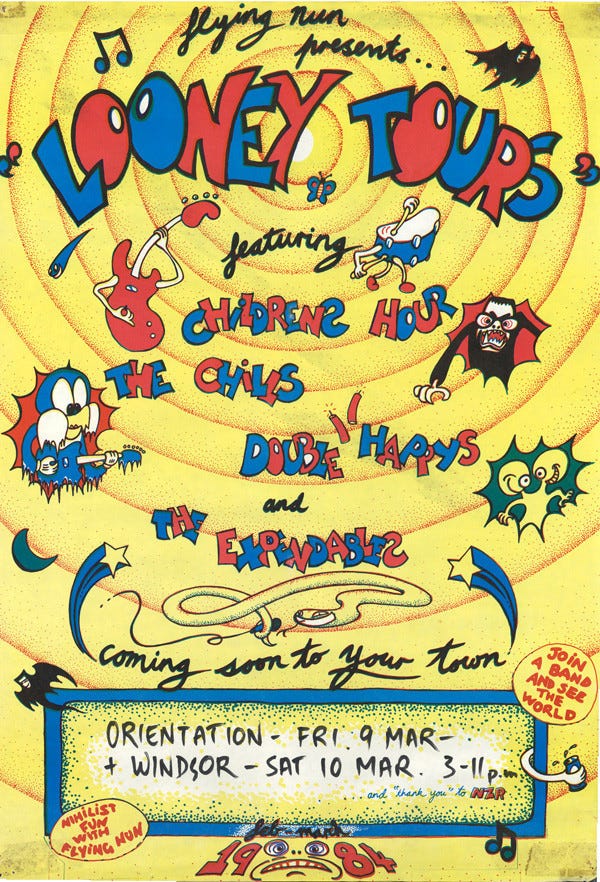
On the gothier side of things, Auckland’s Children’s Hour offer up “Looking For the Sun,” a pounding, magical pool of emotions. It’s Tuatara’s longest song, at over six minutes, and builds in tension as the vocals drop out and the chaos swells; relief comes in the form of silence. The song was the closer to their 1983 12-inch Flesh, and in 1984, they joined a Flying Nun group tour with The Chills, The Expendables, and the Doublehappys. Scene figure Doug Hood put the tour together with his agency Looney Tours, and despite none of the bands having released more than a couple of songs before heading out, it was a success. By the end of the year, Children’s Hour had decided that the band had run its course, but some of its members would soon form Headless Chickens, which went on to greater success by delivering Flying Nun’s only #1 single, “George.”
The Gordons of Christchurch never released original music with Flying Nun, but are featured as #2 on this tracklist. They were a true DIY outfit, with all of their works put out on the self-funded Gordonoid, Inc. In 1988, Flying Nun would reissue their first two releases and put out a cassette compilation with both combined. In contrast to their peers, the Gordons were dark, heavy, and loud. Audioculture.co.nz, whose archival work was essential in crafting this article, said that “sensitive souls complained of hearing loss while enthusiastic skinheads stuffed their skulls into the speaker boxes for an all-out audio assault.” Their track “Coalminer’s Song” comes from their self-titled 1981 album, with nearly 6 minutes of mournful, filtered sludge rock- the sound that would dominate avant-garde post-punks through the rest of the century.
Fetus Productions pushed post-punk freak to an even deeper, clinical level. They spun off from punk band the Features and took a more industrial, art-world approach to being a band, equally concerned with sound, visuals, and fashion.
“I was inspired by images found at various medical libraries of genetic mutations found in humans and animals and began to Photostat the images and cut them into collages,” Town has said. “I showed them a friend, Mike Brookfield, and he was inspired to create many works with fluorescent colours on canvases.” - Jed Town
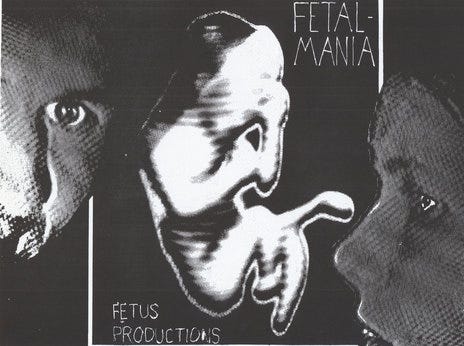
The band left New Zealand in 1981, but they kept their connections to home. Their first label release was with Flying Nun in 1983, an EP called “Fetalmania” that featured the project’s most “song-oriented” work and their biggest success in the alternative sphere. This included comp track “State To Be In,” built from mechanical loops and vocal manipulation. I’m not sure the music video I found online is official, but the juxtaposition of a mundane, time-lapse cafeteria with overlaid flames seems like a Fetus Productions vibe.
Marie and the Atom were experimental as well, made up of Gill Civil, Sara Westwood, and Virginia Were, making them Flying Nun’s first all-female group. Civil was a classically trained pianist, but had already played in a few rock bands and was a member of the Big Sideways collective, a “government scheme for unemployed musicians.” When Civil needed a new creative outlet, she began street performing with strange costumes and musical elements. There she met Were, an art student who would play drums and eventually start experimenting with guitar. Westwood, an architecture fan, joined when the initial pair started exploring demolition sites, which inspired some of their future collaborations. The haunting composition “Isol” features a fretless bass, two violas, and a violin, guided by Civil’s affecting vocals. The track comes from the band’s first album, Yellow Read Aloud, which was funded by a small Arts Council grant in 1983. Knox and other Flying Nun artists had come to know Civil through her street performances, so the label offered to put out 500 copies. Civil says she never saw any profits, despite the album receiving multiple pressings. The band would release a cassette on Industrial Tapes and one other Flying Nun collaboration, this time a 12”, before losing connection.
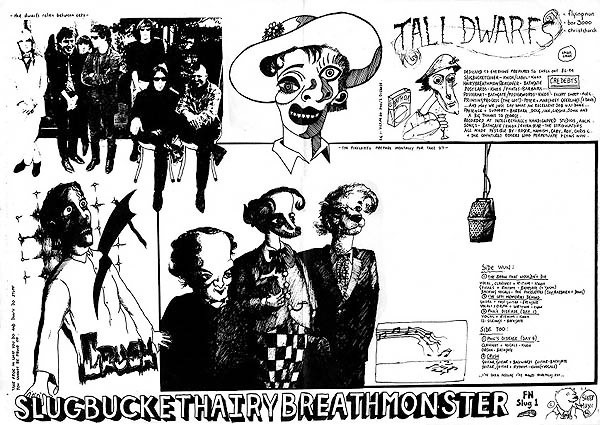
And then there’s Tall Dwarfs. Chris Knox and Alec Bathgate’s post-Toy Love project that defies all typical conventions of the music industry in favor of raw 4-track insanity. Toy Love had ended things in 1980, and while Knox was more keen on recording new bands and working on his solo craft, he was still interested in continuing a creative partnership with Bathgate. A year later, they would re-emerge with Three Songs, an EP on Furtive that utilized toy instruments and ramshackle compositions that resembled nursery rhymes more than rock music. Some Toy Love fans were dismayed, as Knox described their new performances as “two minutes of song followed by five minutes of fucking around.” But the change-up would prove good for the duo as the project lasted for decades and garnered its own legion of devotees in the Elephant 6 movement. “The Brain That Wouldn’t Die” is the opener of the 1984 EP Slugbuckethairybreathmonster, their third with Flying Nun, a hypnotic stream of consciousness delivered in a breathless run-around-the-room style (one take, so Knox claims). Inspired by the 1962 horror movie of the same name, the music video looks like a lo-fi German expressionist movie, with white face paint and practical effects abound.
So what does this record have to do with the tuatara, other than its Kiwi origins? I could make a vague comparison between the species’ longevity and the legacy of a compilation. Its endangered status is similar to that of the DIY cultures Flying Nun was brought up on. But that feels like a cop out. It’s really like if American record themed itself after the bald eagle. Animals are cool.
Other Versions
Only four years into their tenure, and 12 bands weren’t enough for Flying Nun to show off their roster. When the European CD version of Tuatara came out in 1988, it included extra tracks from Scorched Earth Policy and the Doublehappys, who are both thanked in the original liner notes, but also a song by Look Blue Go Purple, who joined the Flying Nun roster the same year that the original compilation came out. The Doublehappys track “Needles and Plastic” would end up lending its title to a retrospective book on the label in 2022.
Score
Variety: 3/5
Quality: 4/5
Cohesion: 4/5
Creativity: 5/5
Final Score: 17/20