

Compilation Nation: Something Wild
Or, DJ Demme

Stats
Year: 1986
Country: U.S.
Genre: New Wave
Purchase
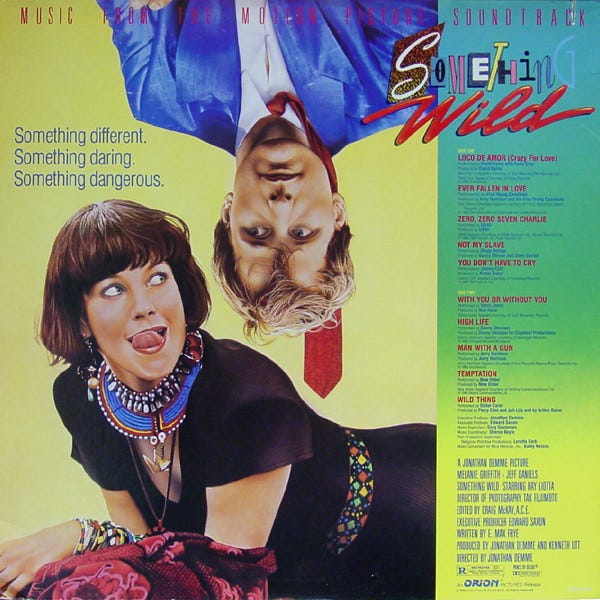
To prove the point that there aren’t enough GOOD pop movie soundtracks on vinyl, this is the first time I’ve reviewed one since 2023! I always check the soundtrack section when I go to the record store, and finally, Academy Annex delivered the goods. 1986’s Something Wild is a dynamic mix of new wave, synth-pop, and reggae that could only be delivered by one very unique vision. Jonathan Demme was one of the most musically literate directors of the 20th century. Of course, his direction of Stop Making Sense is more than enough to prove that fact, but there’s also his music videos with Neil Young, Bruce Springsteen, New Order, etc. This is the man who heard the song “Goodbye Horses” in a taxi cab and loved it so much that it was included in two of his movies. This is the man who fell so in love with Haitian music that he produced his own compilation of it, which was a favorite of Lou Reed.
And despite the fact that Demme knew music, 1986’s Something Wild was the first time it played a major role in one of his narrative films. His first pop soundtrack for Crazy Mama was full of ‘50s classics and never had a vinyl release, but Something Wild was current and innovative. Did it have commercial value? I’m not so sure. The album only charted in Australia (peaking at 62), and The Village Voice gave it a B+ for “novelty fetishism.” At least they said it was better than the soundtrack for Top Gun.
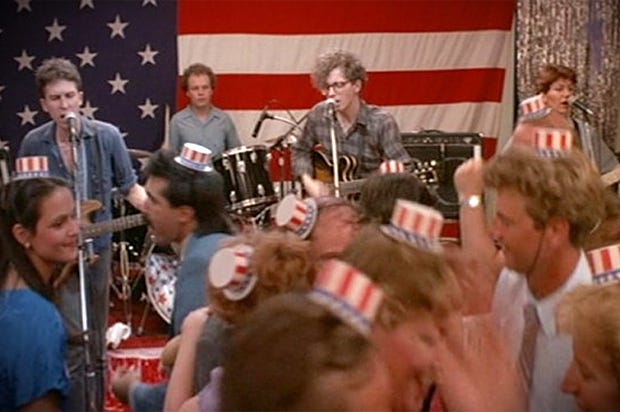
The movie follows a New York yuppie (that’s an ‘80s word for ‘finance bro’) played by Jeff Bridges, who gets caught in the chaotic whirlwind of manic pixie Lulu, played by Melanie Griffith. And of course, they fall in love. There’s a lot of great cameos, Su Tissue, Sister Carol, John Waters, and the Feelies, who play “Fame” and “I’m A Believer” in a high school reunion scene. Sadly, those tracks don’t make it onto the album. It’s not a perfect movie, kind of disjointed and aimless in its plot, but it is a lot of fun.
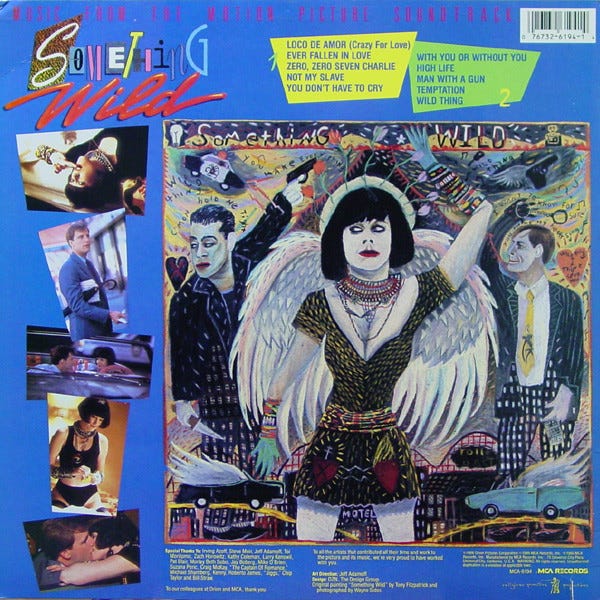
The record was pressed by the supergiant MCA Records in more than eleven countries. The packaging is without thrills but very cute, with the film’s poster on the cover and some stills on the back, framing a painting by Tony Fitzpatrick. Combining cartoons of the actors, lyrics from the titular song, and lots of abstract 80s coloring, the painting is so charming it really should have been the cover!
Content
1986 was the same year that Talking Heads released True Stories, the movie/album combo that explored midwest mundanity with the same level of multi-cultural enthusiasm that Demme approached for Something Wild. He tapped David Byrne for the soundtrack in collaboration with the Queen of Salsa, Celia Cruz, resulting in the film opener, “Loco De Amor (Crazy For Love).” The combination of David y Celia (as they’re billed on the tracklisting) works surprisingly well due to their distinct voices. No “azucar” from Celia, but there is a good line about “pizza in the rain.” It feels like a precursor to Talking Heads’ 1988 album Naked, which also took cues from Latin rhythms for the band’s final outing. “Loco De Amor” also appeared on Byrne’s solo jaunt, Rei Momo, in 1989.
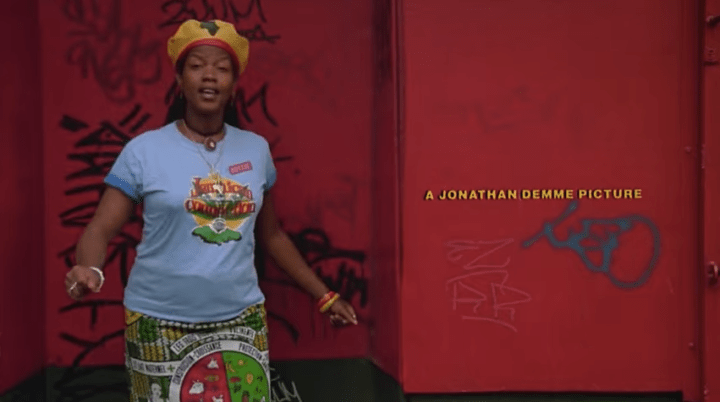
“Loco De Amor” also features interpolation of “Wild Thing” by the Troggs, the original of which does appear in the movie, but not the soundtrack. Deejay Sister Carol ties this theme up with her own cover of “Wild Thing,” which is performed live as the credits roll. As Carol was already a staple in the dancehall community, her skilled toasting shines in this re-interpretation, which even includes some country-style fiddling in its instrumentation. MCA released this track as a promotional 12” single, and later, Carol re-recorded the track with producer Glen Adams in 2020, which is just as good. Carol would go on to appear in three more Demme movies, often as herself.
Back on the T-Heads trail, Jerry Harrison serves up instrumentals on “Man With a Gun,” his first solo work since 1981’s The Red And The Black. Later in 1988, Harrison would flesh out the track on Casual Gods, with an all-star crew of collaborators such as Alex Weir, Bernie Worrell, and Chris Spedding. This version of “Man With a Gun” would appear in the critically panned film Two Moon Junction. Harrison also produced another song on this soundtrack. Two years before their radio hit “She Drives Me Crazy,” Fine Young Cannibals were making strides as their own band apart from the English Beat. They had a top 40 hit with their cover of Elvis’ “Suspicious Minds,” so their Something Wild song followed the same formula, this time with the Buzzcocks. There was a music video that featured singer Roland Gift as a projectionist screening the movie to an audience of bizarre characters. The track would also get an album release as the closer to 1988’s The Raw & The Cooked.
The great Jimmy Cliff, who recently passed, contributed his reggae expertise to “You Don’t Have To Cry,” written by producer Arthur Baker and Steve Van Zandt of the E Street Band. The trio had worked together the previous year on “Sun City,” the Artists United Against Apartheid song that Demme directed a music video for, and which you should watch for the sheer quantity of celebrity talents crammed into Washington Square Park. But the Cliff track is good, not as good as his other soundtrack work, but a solidly breezy choir song with a heaping dose of 80s production.
British reggae group UB40 were three years past “Red Red Wine,” but still releasing an album at the impressive rate of every year or so. Side note: I never realized just how large UB40 was, with eight to twelve members at any point in their career. “Zero, Zero Seven Charlie” is from their “Rat in Me Kitchen” era, and very much sounds like it, getting more experimental with electronic instruments for a real new wave sound. There are no lyrics to this song, which makes the zaniness of the instrumentals a little too clear.
Oingo Boingo makes an appearance with the song “Not My Slave,” a fairly conventional bit of Boingo that was an outtake from the Dead Man’s Party sessions. The subject matter chronicles a difficult relationship, maybe chosen to parallel the one in the movie? The track was later released on their 1987 album Boi-ngo as the third single. Founding Sex Pistol Steve Jones was at the beginning of his solo project when he wrote “With You Or Without You,” a tender pop-rock single that was properly released by MCA the next year. It’s not what you would expect from an anarchist, but Jonesy was always the most subdued of the King’s Road crew.
It’s impressive that for a pop soundtrack, only two of the ten songs had previous releases. New Order’s “Temptation” and Sonny Okosun’s “Highlife.” I feel like for my audience, “Temptation” needs no introduction. It came out five years before Something Wild, but it’s such a perfect carefree bite of synth-pop track that no wonder Demme wanted it in the film. This is, however, a shorter mix than the one most people know, clocking in at 3:28. Sonny Okosun, you might not know as much; the Nigerian guitarist and composer was releasing music since the mid 70s and grew to international acclaim in the 80s. Okosun would often tour with Jimmy Cliff and was, for some reason, the sole African artist featured on the “Sun City” track. “Highlife” was released in 1984 as a 12” single with three different versions: radio, dub, and dance. This is the radio version, which features a clap-along beat and sunshiny vibes. The track-listing on the record, however, spells Okosun’s name with one too many “s.”
Further Listening
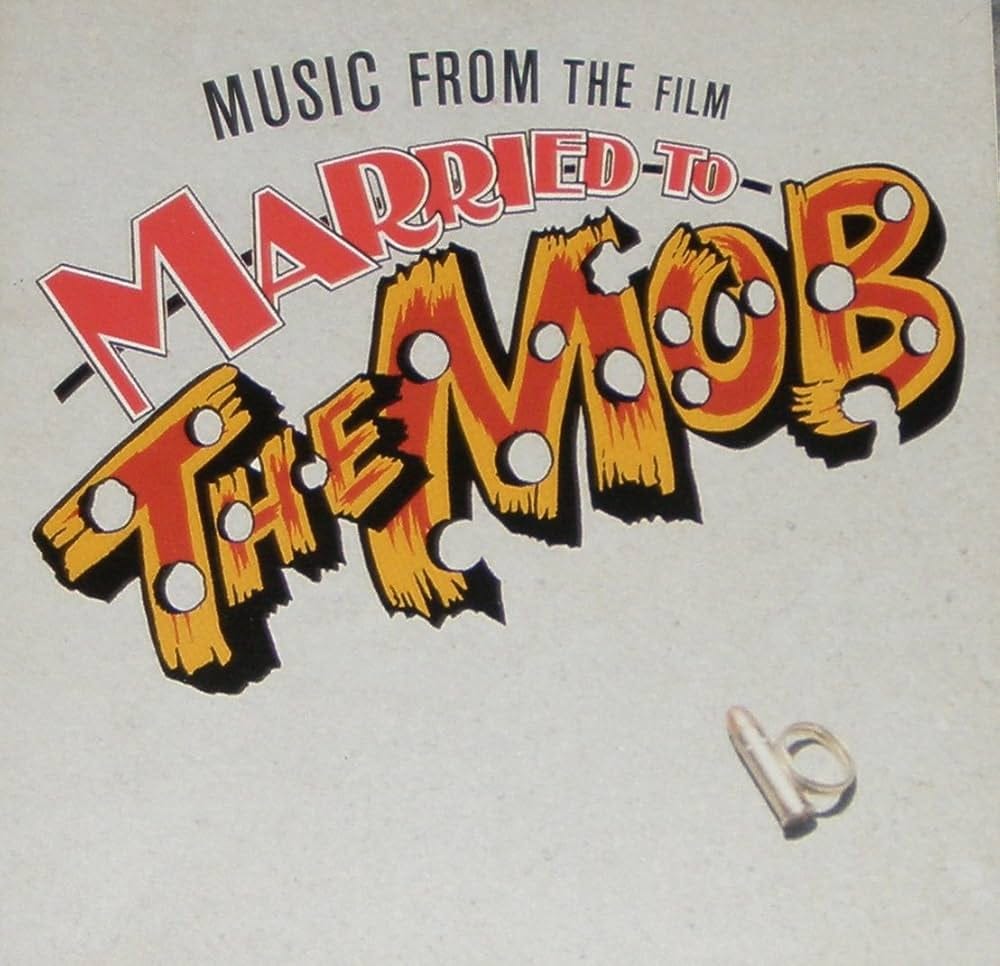
Demme’s next film was Married to the Mob, a crime comedy set in Long Island with an equally 80’s soundtrack. This one is less cohesive than Something Wild, but there are still some gems. Yes, this is the movie that includes “Goodbye Horses” before the famous Silence of the Lambs scene. There’s also originals from Sinéad O’Connor, Chris Isaak, and Brian Eno, a cover of “Liar, Liar” by Debbie Harry, and another New Order classic for good measure (this time it’s “Bizarre Love Triangle.) And the Feelies FINALLY get their soundtrack appearance with “Too Far Gone!” Add in some Ziggy Marley, Tom Tom Club, and a band called the Voodooist Corporation, and that’s a whooooooole lot of 80s.
Score
Variety: 4/5
Quality: 3/5
Cohesion: 3/5
Creativity: 5/5
Total Score: 15/20
Great movie, flawed soundtrack